
.svg)
.svg)
.svg)


.svg)

Introduction
Launching a Shopify store has never been easier—but building a store that actually scales is a different challenge altogether.
Most ecommerce brands start with a theme because it’s fast and affordable. Over time, many realize their store feels generic, performance starts slipping, and conversion rates plateau. This leads to an important question: Is a custom Shopify store worth it, or are themes enough for growth?
The answer depends on where your business is today and where you want it to go. This article breaks down the real differences between theme-based and custom Shopify stores, focusing on growth, performance, and long-term ROI—not just design preference.
Understanding Theme-Based Shopify Stores
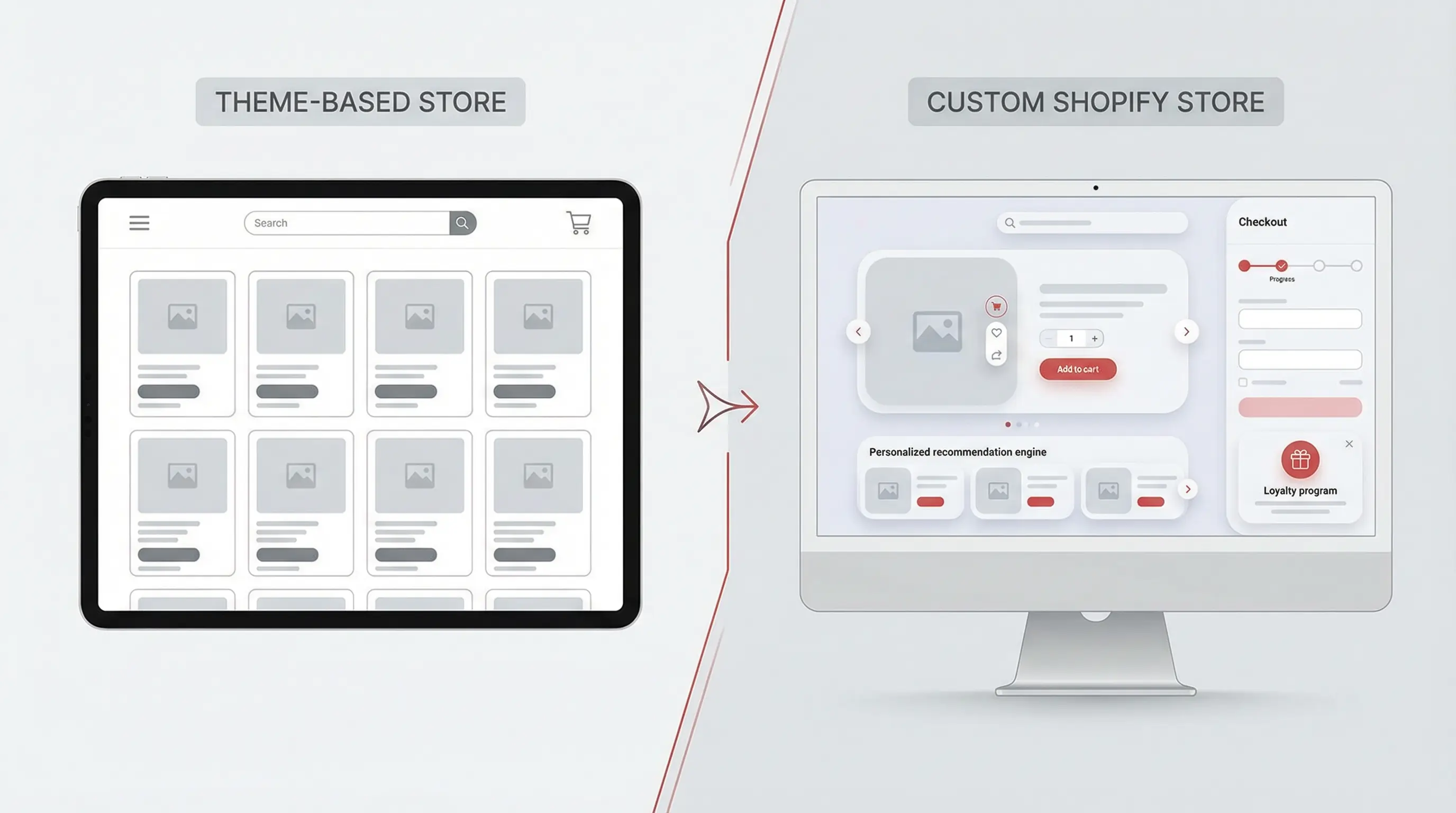
Shopify themes are designed to help merchants get online quickly. They provide pre-built layouts, standard product pages, and basic customization options that work well for early-stage stores.
For new businesses, themes offer speed and simplicity. You can launch quickly, validate products, and start selling without heavy upfront investment. However, themes are built for broad use cases, not specific business models.
As your catalog grows or your brand matures, limitations begin to surface. Layout restrictions, performance overhead, and limited control over user experience often prevent further optimization.
The Hidden Costs of Relying on Themes
Theme-based stores frequently rely on apps to extend functionality. Over time, this leads to script overload, slower page speeds, and inconsistent user experiences. Each added app increases complexity and reduces control.
Design flexibility is another challenge. Making small UX improvements—like custom product flows, unique landing pages, or tailored checkout experiences—often requires workarounds or compromises.
As competition increases, theme-based stores struggle to differentiate. When multiple brands use the same layouts and interactions, standing out becomes harder, even with strong products.
What a Custom Shopify Store Unlocks
A custom Shopify store is built around your business, not the other way around. Instead of adapting to a theme’s structure, the design and development process starts with your customers, products, and conversion goals.
Custom builds allow complete control over layout, performance, and user journeys. Pages are optimized specifically for your catalog, audience behavior, and growth strategy. This results in faster load times, clearer navigation, and stronger brand presence.
From a technical perspective, custom stores reduce dependency on third-party apps by implementing only what’s needed—cleanly and efficiently.
Performance and Conversion Benefits
Performance is one of the biggest differentiators between custom and theme-based stores. Custom Shopify builds eliminate unnecessary code and scripts, leading to faster page loads and better Core Web Vitals.
Faster sites convert better. Users stay longer, browse more products, and complete checkouts with less friction. Over time, even small performance improvements can result in significant revenue gains.
Custom stores also allow deeper conversion optimization. From tailored product pages to dynamic pricing logic and personalized experiences, customization enables experimentation that themes simply can’t support.
Scalability and Long-Term Growth
As ecommerce brands scale, complexity increases. Managing large product catalogs, international storefronts, advanced promotions, and integrated marketing tools requires a flexible foundation.
Custom Shopify stores are built with scalability in mind. They adapt as new features, markets, and channels are introduced—without requiring constant rebuilds.
For brands investing in long-term growth, custom development reduces technical debt and provides a stable platform that evolves alongside the business.
When a Theme Is Still the Right Choice
Theme-based Shopify stores still make sense in certain situations. Early-stage businesses testing products, small catalogs with simple needs, and brands with limited budgets can benefit from themes as a starting point.
The key is recognizing when a theme has reached its limits. Staying too long on a constrained setup can slow growth and increase long-term costs.
Making the Right Decision
Choosing between a theme-based and custom Shopify store isn’t about aesthetics—it’s about alignment with business goals. If speed-to-market is the priority, a theme works. If differentiation, performance, and scalability matter, custom development becomes a strategic investment.
The right time to go custom is when your store becomes a core growth engine rather than just a sales channel.
Final Thoughts
Ecommerce success depends on more than just products. The experience, performance, and flexibility of your Shopify store directly influence how customers perceive and interact with your brand.
Custom Shopify stores aren’t just more polished—they’re built to convert, scale, and compete in crowded markets. For growing brands, the shift from theme-based to custom often marks a turning point in performance and revenue.
Thinking About a Custom Shopify Build?
If your Shopify store feels limited by themes or performance issues, Tupple helps ecommerce brands design and build custom Shopify experiences focused on speed, conversions, and growth.
👉 Book a free ecommerce consultation
.svg)
.svg)
.svg)


.svg)